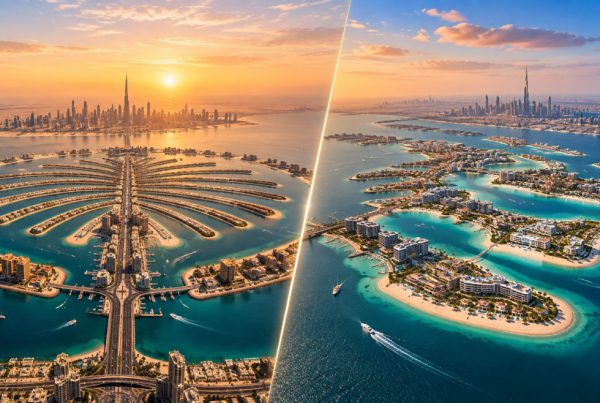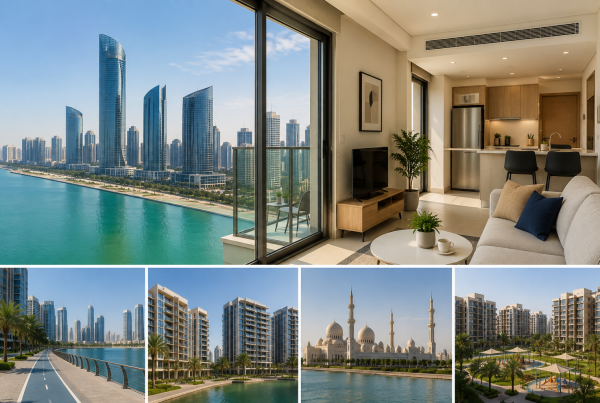
Why Abu Dhabi is better than Sharjah is a comparison that produces genuinely different answers depending on what the investor or resident is optimising for. Both emirates have strong cases. But for buyers who want freehold ownership, stronger infrastructure, higher income stability, and a more internationally recognised address, Abu Dhabi consistently delivers advantages that Sharjah cannot match at the same level. This guide presents the honest case for Abu Dhabi over Sharjah across every dimension that matters in 2026.
Ownership Structure: Freehold vs Usufruct
The single most fundamental difference between buying property in Abu Dhabi versus Sharjah is the ownership structure available to foreign nationals.
Abu Dhabi offers full freehold ownership in designated investment zones. This means foreign buyers receive permanent, unlimited legal title to both the property and the land it sits on, with no expiry date, no reversion clause, and complete freedom to sell, rent, inherit, or transfer the asset at any point.

Sharjah offers a 100-year usufruct structure in its designated investment zones. This grants foreign buyers the right to use, occupy, sell, and inherit the property for a defined period of 100 years, after which ownership reverts to the original landowner. For most practical investment purposes over any realistic holding period, this functions similarly to freehold. But it is not freehold, and the distinction matters legally, psychologically, and in terms of how international buyers perceive and value the asset.
For investors building a long-term portfolio where legal title clarity is a priority, Abu Dhabi’s full freehold structure provides a stronger foundation than Sharjah’s time-limited usufruct arrangement.
Income Stability: Government Employment vs Commuter Demand
Abu Dhabi’s rental market is anchored by one of the most stable employment bases in the UAE. Government institutions, national oil companies, major healthcare providers, and financial institutions employ a large and consistent professional workforce that generates sustained residential demand regardless of broader economic cycles.
Sharjah’s rental demand is heavily dependent on professionals who work in Dubai but choose to live across the border for lower housing costs. This commuter-driven demand is genuine and consistent, but it is structurally dependent on Dubai’s economic performance rather than Sharjah’s own employment base. If Dubai’s job market softens, or if road infrastructure improvements make other affordable Dubai communities more accessible, Sharjah’s commuter tenant pool faces more pressure than Abu Dhabi’s government-anchored base.

For investors who prioritise tenant stability and demand resilience over absolute yield percentage, Abu Dhabi’s employment-driven market provides a more secure long-term foundation than Sharjah’s commuter-dependent model.
Infrastructure Quality and Urban Development
Abu Dhabi’s infrastructure quality is among the highest in the UAE. The capital’s road network, healthcare facilities, international schools, cultural institutions, and retail infrastructure have been built to a standard that reflects decades of sovereign wealth investment in the city’s physical environment.
Sharjah has improved significantly in recent years, particularly through master-planned developments like Aljada, covered in the buying property in Sharjah 2026 guide. But the gap between Abu Dhabi’s overall infrastructure quality and Sharjah’s remains meaningful, particularly outside the newer master-planned communities. Older Sharjah neighbourhoods offer limited amenity by comparison to the established Abu Dhabi communities that have benefited from continuous investment.
Property Prices and What They Buy
The most significant advantage Sharjah holds over Abu Dhabi is price. Comparable property in Sharjah costs 50 to 70 percent less than in Abu Dhabi across most unit types, which is a genuine and meaningful financial advantage.
But what those prices buy differs significantly. In Abu Dhabi, a one-bedroom apartment at AED 500,000 on Al Reem Island puts the buyer within walking distance of major employment hubs, within reach of world-class cultural institutions on Saadiyat Island, and inside a freehold ownership structure with the capital’s full infrastructure quality surrounding it.
In Sharjah, AED 500,000 buys a larger apartment in a community that may require a daily commute to Dubai for work. The space advantage is real. The infrastructure and ownership quality comparison is less favourable.
For buyers whose primary goal is maximum space per dirham, Sharjah wins clearly. For buyers who value ownership certainty, employment proximity, and infrastructure quality alongside their property investment, Abu Dhabi delivers a more complete package at a higher price.
Rental Yields: Where Sharjah Holds Its Ground
This is where the comparison becomes most genuinely competitive. Sharjah delivers stronger net rental yield percentages than Abu Dhabi across most comparable communities, driven by lower purchase prices relative to achievable rents.
Communities like Al Nahda in Sharjah deliver net yields of 7 to 9 percent, covered in the Sharjah real estate market guide. Abu Dhabi’s strongest yield community Al Reem Island, covered, delivers 6.5 to 8 percent net.
The yield gap is real but narrower than the entry price difference might suggest, because Sharjah’s lower purchase prices are partially offset by lower achievable rents in absolute terms. The net result is that Sharjah wins on yield percentage while Abu Dhabi wins on absolute rental income, tenant stability, and capital value growth.
For a complete UAE-wide yield comparison across both emirates, the UAE rental yield guide for 2026 provides the full data-driven breakdown.
Cultural and Lifestyle Quality
Abu Dhabi’s cultural infrastructure is genuinely world-class. The Louvre Abu Dhabi on Saadiyat Island, the planned Zayed National Museum, Yas Island’s entertainment and Formula 1 infrastructure, and the capital’s established international school landscape collectively create a lifestyle offering that competes with major global cities.
Sharjah has genuine cultural depth, including UNESCO recognition and an impressive museum network. But it does not offer the same breadth of international lifestyle infrastructure as Abu Dhabi. The emirate’s more conservative social environment, which restricts alcohol and certain entertainment formats available elsewhere in the UAE, is a meaningful consideration for some expat buyers when comparing quality of daily life.
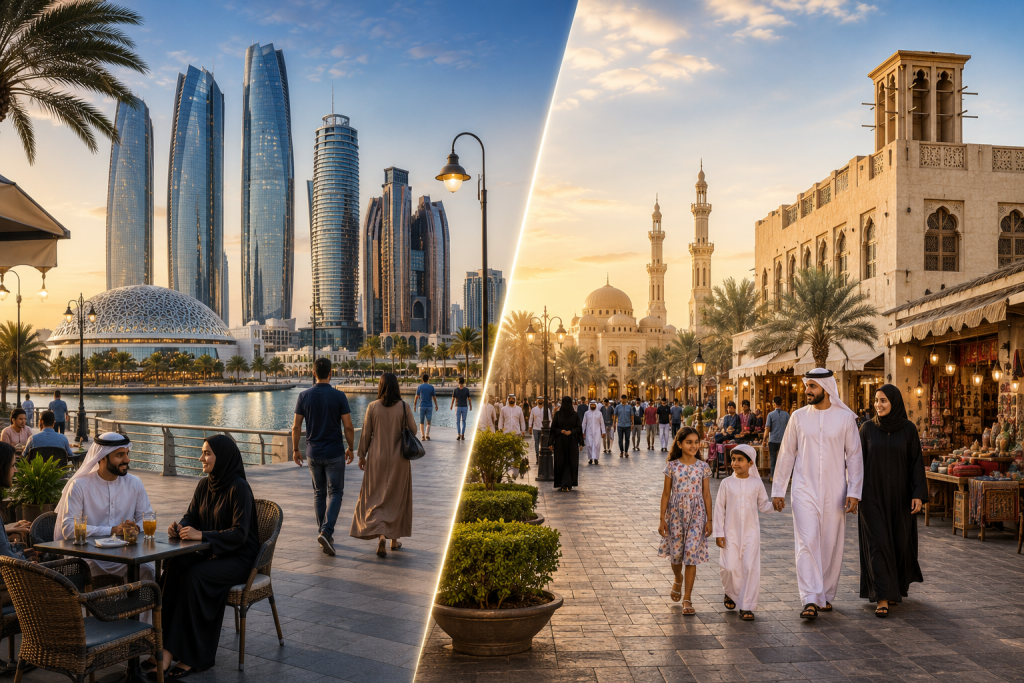
The Saadiyat Island luxury living guide and the Yas Island vs Saadiyat Island comparison cover Abu Dhabi’s lifestyle infrastructure in detail for buyers who want to understand what daily life in the capital actually looks like.
Emerging Market Opportunities in Abu Dhabi
Abu Dhabi’s emerging markets offer genuine early-stage growth potential that is sometimes overlooked by investors who focus exclusively on the capital’s established premium communities.
Communities like Khalifa City offer accessible villa living at prices significantly below comparable Dubai or even some Sharjah villa communities. Masdar City is building a unique innovation and sustainability economy positioning that has no direct equivalent elsewhere in the UAE. These opportunities are covered in the emerging property markets in Abu Dhabi guide
Frequently Asked Questions (FAQ)
Is Abu Dhabi more expensive than Sharjah for property?
Yes, significantly. Property in Abu Dhabi typically costs 50 to 70 percent more than comparable Sharjah properties across most unit types. The premium reflects Abu Dhabi’s full freehold ownership structure, stronger employment base, higher infrastructure quality, and more internationally recognised address.
Which has better rental yields, Abu Dhabi or Sharjah?
Sharjah delivers slightly stronger net yield percentages, typically 7 to 9 percent in top communities, compared to Abu Dhabi’s 6 to 8 percent. However, Abu Dhabi delivers stronger absolute rental income, more stable tenant demand, and more predictable long-term capital growth.
Can foreigners buy freehold property in Abu Dhabi?
Yes. Foreign nationals can purchase freehold property in Abu Dhabi’s designated investment zones including Al Reem Island, Yas Island, Saadiyat Island, Al Raha Beach, and Khalifa City, with full and permanent legal ownership.
Is the commute from Sharjah to Abu Dhabi practical?
No. Sharjah and Abu Dhabi are not comparable commuting options. Sharjah’s primary tenant base commutes to Dubai. Abu Dhabi residents work primarily within the capital. The two emirates serve entirely different employment markets.
Which is better for families, Abu Dhabi or Sharjah?
Both suit families, but for different reasons. Abu Dhabi offers superior international school options, world-class cultural and entertainment infrastructure, and a wider range of family housing formats. Sharjah offers significantly more space per dirham and a quieter, more conservative community environment.
Abu Dhabi is not better than Sharjah in every respect. Sharjah wins on price, space, and yield percentage. But Abu Dhabi wins ownership certainty, employment stability, infrastructure quality, lifestyle breadth, and long-term capital value. For investors who are weighing these factors seriously, Abu Dhabi’s comprehensive advantages over Sharjah justify its higher price point for the right buyer profile.
To explore current property opportunities across Abu Dhabi’s leading communities, browse properties for sale in Abu Dhabi and compare against properties for sale in Sharjah to understand what each emirate offers at current market prices.