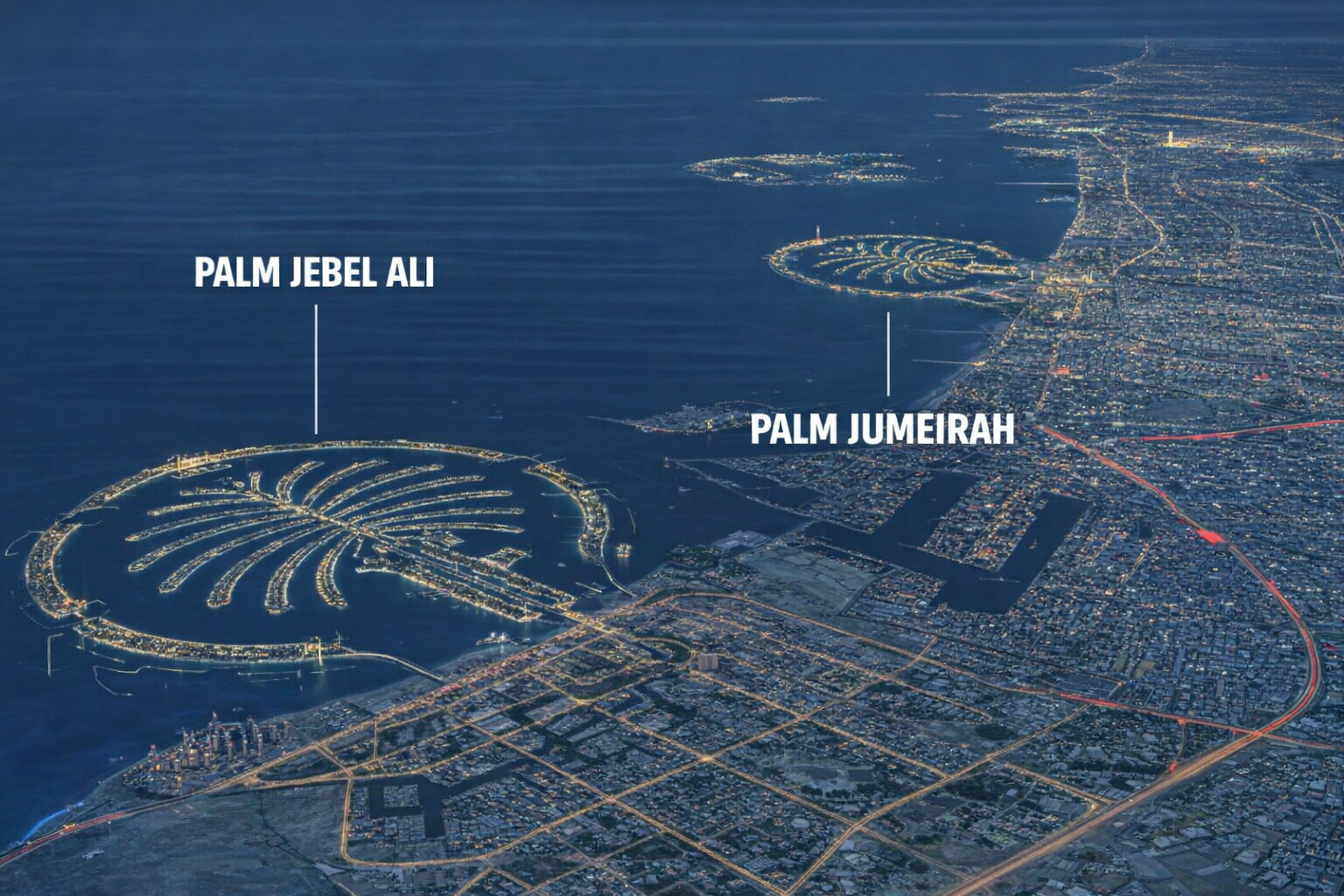
The Island Making Headlines Across Dubai Real Estate
When a single development accounts for 19 percent of an entire city’s luxury property sales in a single month, it is worth paying attention. That is exactly what Palm Jebel Ali achieved in April 2025, generating over AED 11.3 billion in transactions in 30 days. The numbers are striking, but so is the broader story behind them.
Dubai Palm Jebel Ali is a man-made island that was conceived in 2001, built to its land reclamation stage by 2006, abandoned through 15 years of dormancy following the 2008 financial crisis, and then brought back to life in 2023 with one of the most ambitious residential masterplans the region has seen. Today it sits at the centre of Dubai’s growth plans, backed by state money, global architects, and a government mandate tied to the city’s long-term economic agenda.
This guide is written for anyone trying to make a genuine decision about Palm Jebel Ali: whether to buy, whether to invest, what the property options look like right now, and what the honest trade-offs are between this island and the more established Palm Jumeirah. No sales pitch. No speculation presented as certainty. Just the facts as they stand in early 2026.
Key stat: 605 villa transactions on Palm Jebel Ali over the past year vs 136 on Palm Jumeirah. Off-plan demand is running more than four times the rate of its more established neighbour.
Understanding the Scale of What Is Being Built
Palm Jebel Ali Dubai is not a minor extension of an existing concept. It is roughly twice the size of Palm Jumeirah, the world’s most recognized man-made island. With 16 fronds extending from a central trunk, a total land span of 13.4 kilometers, and 91 kilometers of beachfront, it is designed to be a standalone city district rather than a single community development.
The full buildout envisions approximately 35,000 families as residents, supported by 80 hotels and resorts, retail corridors, marina facilities, public beach access, kilometers of green parkland, and a walkable central hub connecting the fronts. All of this is aligned with the goals of Dubai’s Urban Master Plan 2040, which calls for the creation of major new urban nodes to absorb the city’s projected population growth over the coming two decades.
Compared with Palm Jumeirah, the scale difference is stark. But scale alone does not tell the full story. Palm Jumeirah is operational, established, and filled with restaurants, hotels, and a functioning community. Palm Jebel Ali is currently a construction site. That gap is precisely where the investment argument lives.
The Palm Jebel Ali Location Explained
The Palm Jebel Ali location places it in southwest Dubai, beyond Dubai Marina and the established Palm Jumeirah corridor. Its immediate neighbours are Expo City Dubai to the east and Jebel Ali Port to the west, with Sheikh Zayed Road serving as the main arterial connection to the rest of the city.
From Downtown Dubai, the current drive time runs between 45 and 55 minutes in moderate traffic. That is a meaningful consideration for buyers who need regular access to central Dubai for work or lifestyle. The access road from Sheikh Zayed Road to the island is under active construction and once complete it will simplify the approach significantly.
The adjacency to Expo City Dubai deserves emphasis. Since Expo 2020, the district has been repositioning itself as a permanent hub for technology, sustainability, and international business. Major companies have established regional headquarters there, and the convention and events calendar make it one of the most active business districts in the UAE outside central Dubai. For buyers working in or near that corridor, the Palm Jebel Ali location moves from being a drawback to being a genuine advantage.
As of early 2026, the island is not publicly accessible. The main entrance is blocked while infrastructure construction is active. This changes once the access road and initial frond infrastructure reach their completion milestones, expected in Q4 2026.
Who Is Behind the Development
The master developer of Palm Jebel Ali is Nakheel, the organisation that built Palm Jumeirah and several other major reclaimed land projects across Dubai. In 2024, Nakheel became part of Dubai Holding Real Estate, a state-owned group, consolidating the project under direct government oversight. This structure is significant for buyers assessing delivery risk. Projects under Dubai government entities carry a different risk profile compared with purely private developments.
AED 750 million in infrastructure contracts have been awarded. Nakheel has publicly committed to completing all island infrastructure by Q4 2026. Three separate contracts were tendered and awarded to progress the road networks, utilities, and coastal infrastructure that will support the residential and commercial phases.
In July 2025, Dubai Holding signed an agreement with Select Group, a respected private developer with a portfolio across Dubai Marina and surrounding areas. This was the first time a private developer was formally confirmed on Palm Jebel Ali, and it was widely read as a signal that institutional and market confidence in the project is high.
On the architectural side, Nakheel selected six firms with international standing: WATG, SAOTA, Whitespace Architects, NAGA Architects, LOCI, and LW Design Group. Their collective output is ten distinct villa design concepts spread across the Beach Collection on the fronts, making this one of the most architecturally varied residential island developments in the region.
Palm Jebel Ali Property Options: What You Can Actually Buy Today
The residential offering on Palm Jebel Ali villas currently breaks into three distinct categories, each at a different stage of development and availability.
Beach Collection Villas
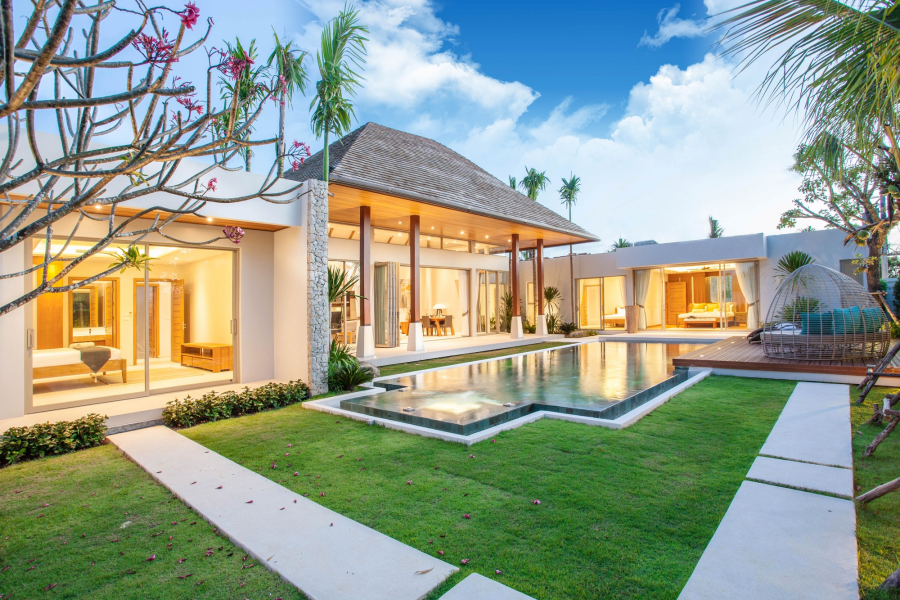
The flagship offering. Five and six-bedroom villas between 7,300 and 8,500 square feet, each designed by one of the six appointed architecture firms. Buyers choose between ten design styles, which range from the contemporary coastal approach of SAOTA to the more organic tropical vocabulary of LOCI. Prices start from AED 18 million.
Several clusters of Beach Collection villas have already sold out. The phases designed by SAOTA, NAGA, and WATG were all sold quickly after launch, and resale opportunities in those phases now command a premium above the original launch price.
Coral Collection Villas
The Coral Collection provides a second tier of villa produce with different architectural treatments. Entry pricing also starts from AED 18 million. This collection has become an accessible route for buyers who want to be on the island at a realistic price point relative to what comparable space would cost on Palm Jumeirah.
Palm Central Private Residences (Apartments)
The first apartment development on Palm Jebel Ali. Palm Central Private Residences offers 212 units across three mid-rise buildings in the Palm Central district. One to five-bedroom layouts are available. Precise pricing has not been publicly released; buyers can register interest for early access. This project introduces a lower entry point to the island and broadens the potential buyer profile significantly.
| Collection | Type | Size | Starting Price |
| Beach Collection | 5-6 Bed Villa | 7,300 to 8,500 sq ft | AED 18 million |
| Coral Collection | 5-6 Bed Villa | Varies by frond | AED 18 million |
| Palm Central | 1-5 Bed Apartment | Low to mid-rise | TBC on registration |
The Investment Case: Numbers First
Investment decisions should start with data, so here is what the data shows for Palm Jebel Ali Dubai as of early 2026.
In April 2025, the island generated AED 11.3 billion in property transactions and accounted for 19 percent of all luxury sales in Dubai that month. Villa transaction volume over the past year totalled 605 units compared with 136 on Palm Jumeirah, a ratio of more than four to one. The average price per square foot is AED 2,750 on Palm Jebel Ali versus AED 4,250 on Palm Jumeirah, a gap of 35 percent. The median villa transaction price sits at AED 21.3 million compared with AED 33 million on Palm Jumeirah.
For investors assessing the upside, the logic is straightforward. If Palm Jebel Ali matures into a community that commands even 80 percent of Palm Jumeirah pricing, the per-square-foot gap narrows from AED 1,500 to roughly AED 650, implying significant capital appreciation on properties bought today. Whether that scenario plays out depends on a number of factors, including delivery timelines, community development, and the broader Dubai property cycle.
| Bullish Factors | Risk Factors |
| 19% of Dubai luxury sales in April 2025 | Full completion not until 2030 |
| AED 11.3B+ in transactions in one month | No hotel operators named yet |
| 605 villa sales vs 136 on Palm Jumeirah | No public transport confirmed |
| 36% lower price per sq ft than Palm Jumeirah | No community services open yet |
| State-backed: Dubai Holding, not private | 45 to 55 min drive to central Dubai |
| Aligned with Dubai Master Plan 2040 and D33 | Off-plan risk over a long horizon |
The government’s backing of the project through Dubai Holding and Nakheel is a structural advantage that pure private-sector developments do not have. The alignment with the D33 agenda and Urban Master Plan 2040 means there is policy and budget committed to making the corridor around Palm Jebel Ali succeed as a functioning urban district.
Construction Timeline: What to Expect and When
This is the question buyers ask most frequently, and the answer requires distinguishing between different phases of the project.
Island-wide infrastructure, meaning roads, utilities, and coastal structures, is scheduled for completion by Q4 2026. Department of Land and Development inspection reports from October 2025 showed the most advanced villa cluster, a set of 108 units on Frond O, at 22 percent completion at that point. Several other villa clusters have moved into full superstructure development, meaning foundations are down, and above-ground construction is active.
First villa handovers for purchasers in the earliest phases are projected for 2027 and 2028. Full island completion, meaning all phases including hotels, apartments, retail, and public spaces, carries a target of approximately 2030. For context on ambition versus reality, the complete vision includes towers, parks, beaches, and 80 hotels for none of which operators have yet been named.
The honest assessment is that by 2028 the island will likely have occupied villa clusters and partial infrastructure, but it will not function as the fully rounded community that is ultimately envisioned. Buyers should plan their expectations around a phased emergence of community services between 2028 and 2032.
Lifestyle Reality: What Living There Will Actually Look Like
The vision for living on Palm Jebel Ali is genuinely compelling: private beachfront access from every villa, enormous plots at prices well below Palm Jumeirah equivalents, modern purpose-built infrastructure, proximity to a growing business district, and the identity of being a resident on one of the most ambitious islands in the world.
The current reality is different. There are no operational schools, hospitals, supermarkets, or restaurants on the island as of early 2026. The entrance remains closed to the public. The drive to central Dubai is nearly an hour in normal traffic. There is no public transport. For the next two to three years at a minimum, anyone living on the island will be living in a construction environment, making regular long drives for all daily necessities.
The public infrastructure that makes the lifestyle case most compelling: kilometers of public beach, green parks, walkable retail zones, and leisure areas connecting the fronts to the central stalk hub, sits in later phases of the masterplan. It will come, but the timeline for a genuinely livable community is realistically 2028 at the earliest for the most advanced fronts, and several more years beyond that for the full island.
Who Should Consider Buying Now
- Investors with a five-to-ten-year horizon who are comfortable with off-plan risk and are focused on capital appreciation
- Buyers who do not need to occupy the property immediately and plan to rent it out once handover occurs
- High-net-worth individuals seeking a second home in Dubai who already have a primary residence established elsewhere in the city
- Buyers motivated by having beachfront freehold property in Dubai at the current entry price before the gap with Palm Jumeirah narrows
Who Should Wait
- Families who need schools, hospitals, and daily infrastructure in place before moving
- Buyers who want to live on the island as a primary residence within the next two years
- Those whose work requires regular access to central or northern Dubai, where the commute becomes a daily burden
- Investors who need short-term rental yield and cannot wait for the community to reach a level of maturity that supports competitive rental rates
Palm Jebel Ali vs Palm Jumeirah
If you’re trying to decide between Palm Jebel Ali and Palm Jumeirah, it really comes down to what you’re looking for. Palm Jebel Ali is massive twice the size of Palm Jumeirah and offers a huge 91 kilometers of beachfront. Both have 16 fronds, so that’s a tie. Price-wise, Palm Jebel Ali is much more affordable right now, with an average of AED 2,750 per square foot and villas going for around AED 21.3 million. Palm Jumeirah, on the other hand, is pricier at AED 4,250 per square foot and about AED 33 million for a typical villa.
But there’s a catch: Palm Jumeirah is fully built and ready to go. You can move in, book a hotel, and enjoy the community today. Palm Jebel Ali is still under construction and off-plan 80 hotels are planned, but none are open yet. So, if you want something established and hassle-free, Palm Jumeirah wins. But if you’re okay with waiting and want more space for your money, Palm Jebel Ali is a great bet.
Palm Jebel Ali Frequently Asked Questions
Where is Palm Jebel Ali located?
Southwest Dubai, near Expo City Dubai and Jebel Ali Port, beyond Palm Jumeirah
Can foreigners buy property in Palm Jebel Ali?
Yes. All properties are freehold and available to international buyers
What is the villa price range in Palm Jebel Ali?
Villas start from AED 18 million. Median price over the past year was AED 21.3 million
Is Palm Jebel Ali a good investment?
Strong off-plan demand and 36% lower price per sq ft than Palm Jumeirah, but long horizon
Is there public transport?
Not confirmed as of 2026. Car-dependent in the initial phase
Is Palm Jebel Ali sinking?
No, the islands were engineered with advanced land reclamation techniques and protective breakwaters to prevent sinking. While some settling is natural for reclaimed land, there’s no evidence of significant sinking affecting Palm Jebel Ali or Palm Jumeirah.
Why is Palm Jebel Ali empty?
Construction was halted during the global financial crisis in 2008, leaving much of the island’s infrastructure incomplete. Only land reclamation and breakwaters were finished, so residential and commercial areas remained unbuilt for many years.
Why did the Palm Jebel Ali construction stop?
The project paused primarily due to the economic downturn and funding challenges during the global financial crisis, which affected many large-scale Dubai developments at the time.
Can you visit Palm Jebel Ali?
Currently, the island is mostly under development, so general tourism access is limited. Visitors can see parts of the reclaimed land, but most residential and entertainment areas are not open yet.
How many Palm islands are there in Dubai?
Dubai’s master plan includes three major palms:
Palm Jumeirah – completed and inhabited
Palm Jebel Ali – under construction
Palm Deira – partially developed
Is Palm Jebel Ali sold out?
Not entirely. Some plots and villas are available for sale as the developer begins phased construction, and the island is planned to be a freehold property area.
How big is Palm Jebel Ali?
Palm Jebel Ali is approximately 50% larger than Palm Jumeirah, making it the biggest of Dubai’s planned palm-shaped islands. Approx 16 fronds, 13.4 km span, 91 km of beachfront
What will be on Palm Jebel Ali?
The island is planned to host luxury villas, hotels, entertainment areas, marinas, theme parks, and commercial districts once fully developed.
Who owns and built Palm Jebel Ali?
The development is led by Nakheel, the same developer responsible for Palm Jumeirah. The project was designed by engineers and planners specializing in large-scale land reclamation projects.
Can Palm Jumeirah or Jebel Ali sink?
Both islands were constructed with reinforced sand and rock breakwaters. While minor settling is normal, there is no risk of the islands sinking in any major way.
What This All Adds Up To
Palm Jebel Ali is real, it is funded, it is under active construction, and the transaction data from 2025 confirms that sophisticated buyers are already committing to it in significant numbers. The price gap with Palm Jumeirah is the central investment argument, and it is a credible one given the government commitment behind the project and the trajectory of Dubai’s population and wealth growth.
The risks are also real. The timeline is long. The community does not exist yet. No hotel operators are confirmed for the 80 planned hotels. And anyone buying into an island that is still a construction site is accepting a level of uncertainty that a ready property simply does not carry.
The clearest way to frame the decision is this: if you are buying Palm Jebel Ali today, you are buying Dubai’s growth story for the next decade, at a meaningful discount to its most comparable reference point. If that matches your investment horizon and risk of tolerance, the fundamentals are there. If you need a liveable community today, Palm Jumeirah remains the answer.
For new phase launches, pricing updates, and early registration on Palm Jebel Ali, check back regularly as new information becomes available through 2026 and beyond. Visit properties.market now!